


Dowling Duncan and redesigning the American Dollar:
Why the size?
We have kept the width the same as the existing dollars. However we have changed the size of the note so that the one dollar is shorter and the 100 dollar is the longest. When stacked on top of each other it is easy to see how much money you have. It also makes it easier for the visually impaired to distinguish between notes.Why a vertical format?
When we researched how notes are used we realized people tend to handle and deal with money vertically rather than horizontally. You tend to hold a wallet or purse vertically when searching for notes. The majority of people hand over notes vertically when making purchases. All machines accept notes vertically. Therefore a vertical note makes more sense.Why different colors?
It’s one of the strongest ways graphically to distinguish one note from another.Why these designs?
We wanted a concept behind the imagery so that the image directly relates to the value of each note. We also wanted the notes to be educational, not only for those living in America but visitors as well. Each note uses a black and white image depicting a particular aspect of American history and culture. They are then overprinted with informational graphics or a pattern relating to that particular image.$1 – The first African American president
$5 – The five biggest native American tribes
$10 – The bill of rights, the first 10 amendments to the US Constitution
$20 – 20th Century America
$50 – The 50 States of America
$100 – The first 100 days of President Franklin Roosevelt. During this time he led the congress to pass more important legislations than most presidents pass in their entire term. This helped fight the economic crises at the time of the great depression. Ever since, every new president has been judged on how well they have done during the first 100 days of their term.Love these.
Cool Design!
What did you use to create your design for the TSWGO t shirt contest?
I used Adobe Illustrator 😀
Admittedly, I have an advantage because J.K. Rowling doesn’t have a tumblr…
But I’m really thrilled that four of my books ended up in the Top 25 of NPR’s all-time Top YA Novels poll, including The Fault in Our Stars at #4 and Looking for Alaska at #9.
The list (Your Favorites: 100 Best-Ever Teen Novels) is up! Five John Green books, four of which made the top 25!
A lot of my favourites on here (though reading over the descriptions all at once ws a bit overwhelming, lots of heavy topic matter – though there are some lighter reads that made it too.
There’s also this article Best YA Fiction Poll: You Asked, We Answer! which discusses why some books were cut from the list including Ender’s Game, Walk Two Moons and Ella Enchanted, all favourites of mine.
Happy Reading, those of you who aren’t studying for Summer term exams.
Why Did You Use the Strings?
Where did the strings metaphor inPaper Towns come from?
Someone said it to me once, after a friend had attempted suicide, that “maybe all the strings inside him broke,” and I liked that image a lot because 1. puppets, and 2. We are all aware that there is this emotional/psychological life inside of us, right? But it’s very difficult to talk about, because it doesn’t have a physical location.
When your back hurts, it’s relatively easy to address this problem using language: You say, “My back hurts,” and I can understand what you mean, because I also have a back, and it has hurt before, and I remember that pain, which makes it easier for me to empathize with you.
It is much harder for me to empathize with you if what hurts is abstract. When people are imagining sadness or despair, they often try to render it in terms we find familiar. You often hear, “My heart hurts,” for instance, or “My heart is broken.” This problem, of course, is not actually in the heart.
(I do think a lot of people feel emotional pain physically near the solar plexus, but it’s not the physical manifestation of emotional pain that makes it so difficult: It’s the emotional/psychological/spiritual/whatever pain itself, which you can’t describe easily in concrete terms.)
To talk about emotional pain (and lots of other emotional experiences), we are forced to use abstractions. (“My heart is broken,” is a symbolic statement.) And many people feel, in this world driven by data and statistics and concreteness, that abstractions are inherently kind of less valid than concrete observations. But emotional experience is as real and as valid as physical experience. And the fact that we have to use metaphor and symbolism to describe that pain effectively does not make it less real—just as abstract paintings are not inherently inferior to representational paintings.
You often hear in high school English classes, for instance, that thinking about symbols is dumb or useless or “ruining the book.” But underneath it all, this is why we have language in the first place. We don’t really need language to share the news of your back pain: You can point at your back and grimace to tell me that your back hurts, and I can nod sympathetically.
But to explain to you the nature and nuance of my grief or pain or joy, I need abstractions. I need symbols. And the better our symbols are, the more clearly we’ll be able to communicate with each other, and the more fully we’ll be able to imagine each other’s experience. Good symbolism makes empathy easier.
So why the strings? The strings inside a person breaking struck me as a better and more accurate abstract description of despair than anthropomorphized symbols (broken heart, etc.).
And this is very important to remember when reading or writing or painting or talking or whatever: You are never, ever choosing whether to use symbols. You are choosing which symbols to use.

My design for the This Star Won’t Go Out T-shirt Contest.
How John Green Won the Internet
“800 screaming teenagers… waiting to hear an author speak about his literary fiction. It’s enough to give a person hope.”

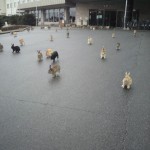


“Ōkunoshima (大久野島) (…) is often called Usagi Shima, or Rabbit Island, because of the numerous wild rabbits that roam the island; they are rather tame and will approach humans.”
So, now I know where I want to live…



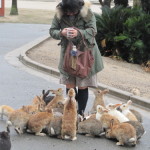
“Ōkunoshima (大久野島) (…) is often called Usagi Shima, or Rabbit Island, because of the numerous wild rabbits that roam the island; they are rather tame and will approach humans.”
So, now I know where I want to live…
Pretty much the coolest thing ever.
(Source: http://www.youtube.com/)