
Drop Everything And Read! Now there’s a day I can get behind!
Tag Archives: books

A Slow Books Manifesto: Read books. As often as you can. Mostly classics.
Why so much emphasis on what goes into our mouths, and so little on what goes into our minds? What about having fun while exerting greater control over what goes into your brain? Why hasn’t a hip alliance emerged that’s concerned about what happens to our intellectual health, our country, and, yes, our happiness when we consume empty-calorie entertainment? The Slow Food manifesto lauds “quieter pleasures” as a means of opposing “the universal folly of Fast Life”—yet there’s little that seems more foolish, loudly unpleasant, and universal than the screens that blare in every corner of America (at the airport, at the gym, in the elevator, in our hands). “Fast” entertainment, consumed mindlessly as we slump on the couch or do our morning commute, pickles our brains—and our souls.
That’s why I’m calling for a Slow Books Movement (one that’s a little more developed than this perfectly admirable attempt).
In our leisure moments, whenever we have down time, we should turn to literature—to works that took some time to write and will take some time to read, but will also stay with us longer than anything else. They’ll help us unwind better than any electronic device—and they’ll pleasurably sharpen our minds and identities, too.
To borrow a cadence from Michael Pollan: Read books. As often as you can. Mostly classics.
Aim for 30 minutes a day. You can squeeze in that half hour pretty easily if only, during your free moments—whenever you find yourself automatically switching on that boob tube, or firing up your laptop to check your favorite site, or scanning Twitter for something to pass the time—you pick up a meaningful work of literature. […]
If you’re not reading slowly, you’re doing yourself—and your community—a great wrong. As poet Joseph Brodsky said in his 1987 Nobel Prize acceptance speech, “Though we can condemn … the persecution of writers, acts of censorship, the burning of books, we are powerless when it comes to [the worst crime against literature]: that of not reading the books. For that … a person pays with his whole life; … a nation … pays with its history.”
Read more. [Image: Reuters]
You know something? As lovely as this sounds in theory. As catchy as that motto is. No.
Let me tell you about classics, long, thousand page novels, spiraling stories about love and betrayal and society and repression. I can tell you about them because I’ve read lots and lots and lots of them. Name one and I’ve probably read it. If I haven’t, I probably will. But I didn’t love all of them. I didn’t even like quite a few of them, and fewer still have changed my life or bettered my person.
The books that stayed with me and that I value reading are the ones that make me feel something, the ones that make me, if only momentarily, escape to a different sort of life. Sometimes it’s short stories. Sometimes it’s old and sometimes it’s contemporary and sometimes it’s something in between. It’s Richard Yates’s trembling middle class suburbia. It’s Colette’s free spirit and petulant eroticism. It’s David Wojnarowicz’s rage and desperation, which you will never, ever find in an English Literature curriculum. It’s stories about sex and seemingly unremarkable people’s extraordinary moments.
And you know something? I read them fast, on subways, in between places, for moments at a time. Or I read them for hours in bed with a cup of tea. It doesn’t matter—reading isn’t something to be ritualized, fetishized, it’s something you do for the pure joy of it. And sometimes it isn’t books. It’s essays, blog posts, even heart breaking 140 characters or less, tweets.
So: Read. When you want to. Mostly good books. But always ones that make you feel, think, and long to be alive. Not to keep the canon of 100 greatest books of all time alive, but to know, to remember, that you’re human, that you feel—that you’re not alone.
YES YES YES YES YES

I think this would be a good book to check out next 🙂
John Green sure didn’t let me down with his recommendation of Anna and the French Kiss. Plus, I like love stories AND math 😉
I just read a book.
My copy of tfios has yet to show up, and I haven’t gotten my hands on lola and the boy next door yet either, so today I made the cold, although short, trek to the library. I got a few books, but the one I read is Story of a Girl by Sara Zarr. What can I say except that I sobbed through the majority of the story. The story brought up some of my own fears and I felt myself close to panicking at a few points, but I stayed okay. It’s the story of a girl Deanne Lambert, who slept with her brothers best friend when she was 13 and he was 17. After almost a year of this, her dad caught them together, and he never looked at her the same since. Now she’s 16 and the boys in her school treat her like public property, her brother is a new father with his own problems, and her two best friends are in love with one another. But they make it through you know? There isn’t a flowery ending or a grand conclusion, just small steps taken to try and make things right and move on.
I don’t like hating things, I don’t like to say I hate things even, but I hate that teenagers treat each other like this. It’s so incredibly heartbreaking. What screwed Deanne’s life was not that she had sex when she was 13. I’m not saying I advocate 13 year olds getting it on, but it wasn’t the ugly thing that it was portrayed at school. She just wanted to feel chosen really, to feel closeness with someone, to have their attention, and that is not a bad thing. What screwed up her life is the way the story was twisted and spread and lingered over, by her classmates and her own father, until she started to believe that was all she was. Pathetic. Trashy. A slut. Yet she wasn’t, she was just a girl, trying to find compassion and love. It’s true that she didn’t find love in Tommy’s 17 year old arms, but that’s all she was really looking for. What right does anyone else have to judge her for that. What right does anyone really have to judge anyone. We just go around in our lives not knowing how to be or what it’s like to be anyone else. But trying to know, trying to feel, trying to understand, I think that’s pretty much the most important thing any of us really ever do. Now I’m tearing up again, but hey, that’s okay. Sometimes I just get scared that we’re not doing it right, we’re wasting all these precious moments we could make things better, but then I take a breath, and say, the only way we can go is forward, so we might as well embrace it and do our best.
And be grateful.
I am so grateful to this author for stirring up these feelings within me so that I am reminded of the things that are most important. So that I can remember to live my life the best I can, even if I’m still scared some of the time. Breaths, one, two three. Breate in and out. I’m also grateful for John Green’s book tfios, even though I haven’t read it yet, because I can feel in my heart from the general themes people have let slip, and the response overall, that it will be a positive and beautiful thing in my life at this time.
It’s okay. Remember to be loving to people, even those who’s choices seem silly, or stupid, or wrong to you, because no matter how smart or experienced or right you are, you still don’t know.
Um, could an ordinary superpower be loving books? I usually have a book with me everywhere I go. I enjoy sniffing old books. Bookstores make me happy.
Yes, definitely!
When I got the idea for drawing Ordinary Superpower comics it was really a combination of two ideas. One was something I read a long time ago, that I don’t even remember the source of, about a boy who wrote stories about people with, well, ordinary superpowers. An example would be having a pinky finger that could turn invisible or was really strong. I honestly don’t even remember if his characters made use of the abilities or if they were sort of useless. The second idea was really just the belief that people are more significant than they realize. That the little things matter. I think that there are two very prevalent viewpoints in our society. One that there are so many people, and that they are so small in the course of everything that they don’t matter, that nothing really matters.
The other is that size, and durability are not really the measures of worth. That small actions can have huge impact or that changing a single life is of huge value. The butterfly effect would be considered a real world example of this phenomenon. I prefer this viewpoint, in which consciousness and life and creativity is considered beautiful and precious despite the abundance of people that have been and will be and I’ll tell you why. I don’t think it’s a question that we’ll ever really have an answer for, and instead of fretting about what is right in cases such as these, I think we should believe what makes us the most inspired, productive, happy human beings possible. After all, even if we’re wrong, we stand more to gain by believing, and trying, and being than we do fretting about the inevitable. I think this makes an incredibly strong argument both for optimism, and against fate.
However, back to your original question, I think loving books is a valid and valuable attribute to celebrate. And my comic really does come down to celebrating things that may be overlooked (in a lighthearted and visually pleasing way.) Reading can open up a world of possibilities, and help create more thoughtful, understanding and empathetic people. It’s really an incredible thing humans have created, that allows not only the passage of information efficiently from person to person through the passage of time, but for many of us to feel slightly more understood, and less alone in this infinite universe.

A doodly cover I made a while ago 🙂
Stephanie Perkin’s Book Recomendations
Now I’ll have some things to look for at the library.
I mean, I’ve read a fair number of these, but still, there’s more!
That Stephanie Perkins, she like, wrote Anne and the French Kiss! eek!
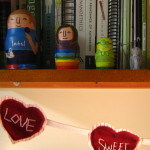
Look at what I made!
The Trouble With Twilight – The damaging effect media, movies and books can have on girls sense of worth and the value they put on romantic relationships. This is an interesting video because the idea that girls need boys affection and attention to feel worthwhile permeates everyday life through media, literature, the internet etc. and yet it is not being discussed with nearly the same vigour as other related issues such as celebrities being poor role models, women being objectified and idealized and sexism in media. I do, however, argue that while twilight is written to be very engaging for those who strongly desire this type of validation from boys, it is not necessarily well written. It is cleverly constructed so that it’s audience does not notice that it is poorly written because they are so absorbed in the story, and don’t care for much but it’s forward progress. Twilight’s construction and raise to fame is quite interesting, and I plan on exploring it more in further blog posts.
Also check out Liz’s follow up video How Books Get Into Our Brain.
(Source: http://www.youtube.com/)

bwahahaha